Visualizing Peace: Student’s Artwork for the Woolman Peacemaking Forum
Submitted by Arabelle Bruner
Article submitted by Arabelle Bruner
Newberg, Ore. — “Listen to me, my people,” the prophet Isaiah writes, “hear me, my nation: Instruction will go out from me; my justice will become a light to the nations.”
With this verse in mind, George Fox University (GFU) held the 2026 Woolman Peacemaking Forum, named after eighteenth century Quaker journalist and abolitionist John Woolman. Every year since its establishment in 1986, the Woolman Forum’s focus has been to instruct, involve and enrich the Newberg community in the peacemaking efforts of their neighbors, both local and international.
A highlight of this year’s forum, entitled “A Light to the Nations,” was a student art exhibit organized by GFU Art professor Tim Timmerman. Early in the year, Timmerman tasked nine of his Art majors with taking a verse of Scripture themed on peace and justice and rendering it artistically.
These students were first assigned a color palette. Next, they had to choose two historical artists as stylistic references. The artists chosen ranged from Art Deco illustrator Roger Broders to 15th century mystic Hildegard von Bingen.
From then on, the students’ only parameter was the limit of their creativity. For junior Illustration major Abby Gorin, creativity was no problem.
Given the mandate of Amos 5:24—“But let justice roll like a river, righteousness like a never-failing stream”—Gorin placed the blindfolded Lady Justice in a flowing water gown front and centre on her poster.
Justice as identified by scripture is the Lord’s but has also often been represented as a woman throughout history. Left to Gorin’s creative liberty, she decided to portray Justice as a female figure. “As a woman myself, why not choose the feminine?” she said. “I’m passionate about making everyone feel included, especially in a world that’s very cookie-cutter.”
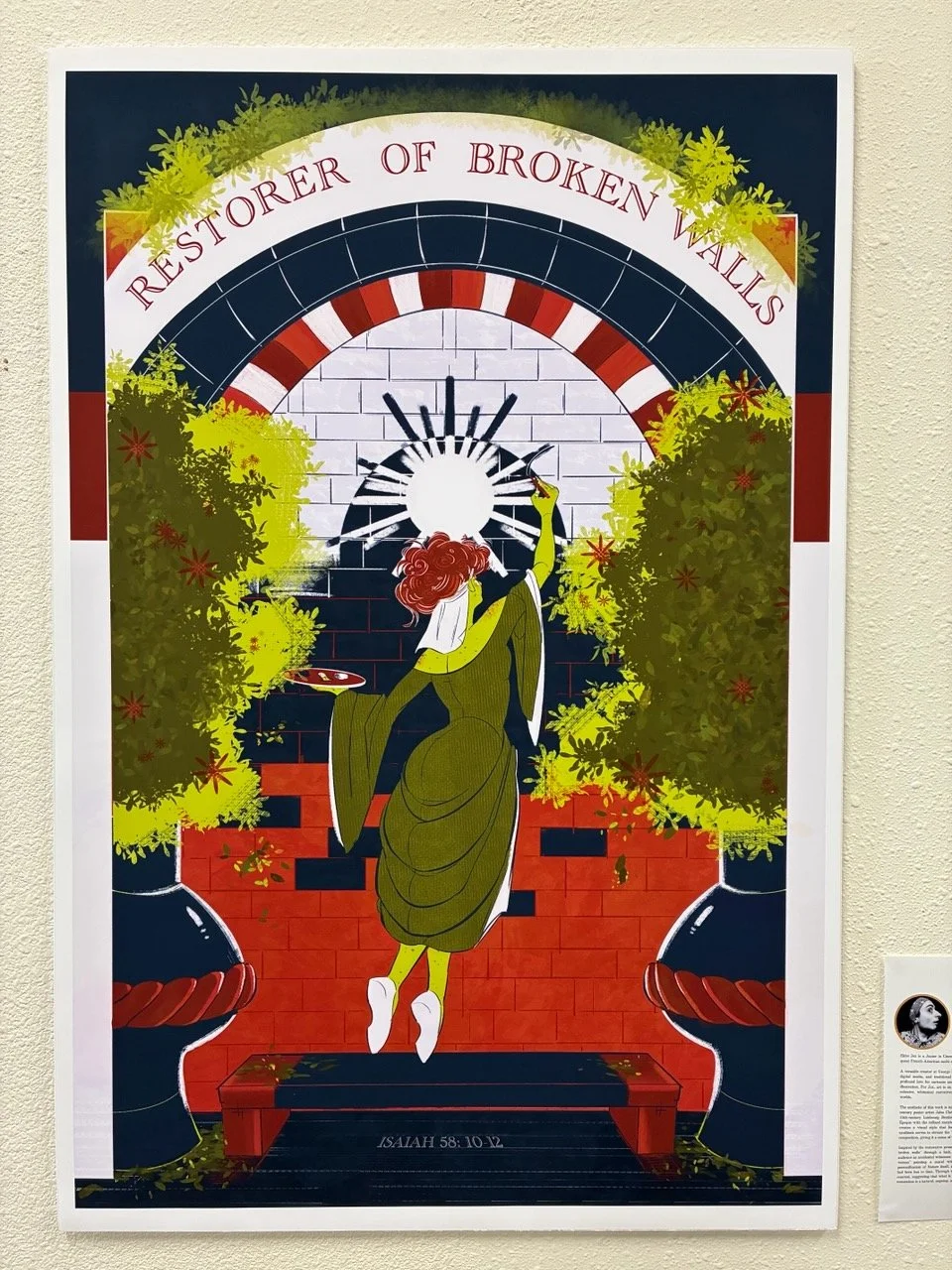
Fostering a welcoming environment for all people is important to junior Animation major Ekho Jox. Jox’s assigned verse was Isaiah 58:12: “Your people will rebuild the ancient ruins and will raise up age-old foundations; you will be called Repairer of Broken Walls, Restorer of Streets with Dwellings.”
As a French-American student, Jox took inspiration from Belle Époque painter Jules Chéret. Like many of Chéret’s artistic subjects, Jox’s poster features a young woman. She faces an aged wall, reaching with a paintbrush in her right hand to restore its faded beauty.
For Jox, art is about taking the works of history and bringing them back to life. “Things don’t have to be created and left,” Jox said. “An idea can be reused and reused and [people] will always come up with something different.”
Animation major and junior Ian Raquel wrestled with how to come up with “something different” when he was presented with his verse, Colossians 1:19-20: “For God was pleased to have all his fullness dwell in Him, and through Him to reconcile to Himself all things, whether things on Earth or Heaven, by making peace through his blood, shed on the cross.”
Christ’s crucifixion has been depicted thousands of times in history. So, Raquel had to take this age-old image and somehow make it new. “I had to figure out how to put more of the message in,” Raquel said.
The answer: outstretched hands. Surrounding the crucifixion-centre of the poster, Raquel drew eleven figures, their hands reaching toward Christ. Some of the hands are human, and are illustrated with strained arms, their palms down, grasping. Other hands are angelic, and those palms were drawn facing up, seeking to help the dying Christ.
“The act of [Christ] on the cross is him crossing a border from human to heaven,” Raquel said.
Junior Jake Edmunds, who concentrates in concept design, approached this project with a unique perspective as a military veteran. After serving for nine years in the United States Marine Corps, Edmunds eventually found his way to serving God through creation.
For many, peace and justice appear as contradictory concepts. Edmunds understands them harmoniously. “Many people think peace is the absence of violence,” he explained. It is his different understanding that is conceptualized in his poster, a rendering of Isaiah 51:4, the forum’s central verse.
Above the written words, “My Justice will be a light to the nations,” Edmunds drew a heavenly sword carrying two lanterns on its hilt. The lanterns shine on a city below, leaving no building untouched by their light.
“When it comes to divine peace, it’s more about…absolute trust in the Lord that he will provide,” Edmunds said. “That’s the greatest form of peace: still being drawn to God, knowing that the peace of the Lord will sustain you…when you go through trials.”
.
In response to the question, “How do you foster peace in your day-to-day life?” Each artist provided a different answer.
For Gorin, it’s through grace. “I foster peace by giving myself grace and giving grace to other people,” she said. “Taking a moment.”
For Jox, it’s through silence. “It’s not necessary to always have a response to something,” Jox explained. “Sometimes being at peace with silence is the biggest power you can have.”
For Raquel, it’s through kindness. “I consistently show kindness in small ways,” he said. “And if I can show instead of tell, I’m more drawn to that.”
For Edmunds, it’s through service. “I thank Him that He places me in situations… where I can be of service to others,” he said. “Every moment you have to serve others, you’re serving the Lord.”
When visualizing peace, these artists discovered different angles of representation for the virtue, which helped them better understand what peace means in their own lives. As described by the 2026 Woolman Peacemaking Forum website, one goal of the forum was to discover practical ways of living out peace in anxious times. Through their artwork, these students did just that.