
A Forum of Flourishing
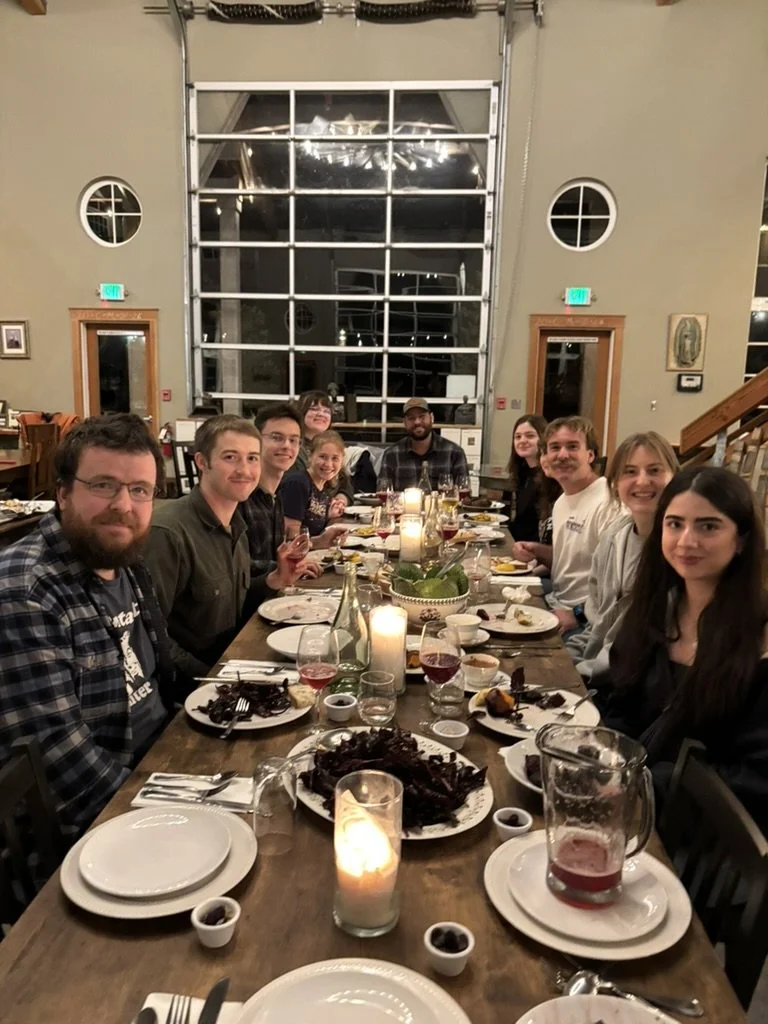
Photo submitted by Reese Borchert
Article by Reese Borchert
Newberg, Ore. – A rare opportunity was presented to George Fox University (GFU) students on Feb. 13 to escape the world’s often excessive stimulation. Those who expressed interest were instructed in an email to read the first seven chapters of The World Beyond Your Head by Matthew Crawford and arrive at Lady Hill Farm and Winery at 1 p.m. in work clothes.
“The opportunity is to be alive,” said Jerry Owen upon welcoming us to his property. The sky was gray, the air was crisp and the group anticipated instructions around a crackling fire.
“We’re going to encounter the real,” said Owen as he outlined the day’s activities. The group, composed of 10 GFU students, chose to spend their Friday of Mid-Semester Break in pursuit of that promise.
They were accompanied by Assistant Professor of Theology & Ethics, Travis Pickell, who partnered with the Intercollegiate Studies Institute (ISI) to arrange the event, as well as Associate Professor of Civil Engineering, Benjamin Giudice.
“Jerry is an interesting guy and a big fan of classic and Christian education,” said Pickell. This was evident in Owen’s integration of the book’s central themes. Pickell selected the text and topic while Owen highlighted corresponding farm practices. He proudly displayed his makeshift firepit and conveyed that humans have exchanged the elation of problem-solving and creativity for convenience and the spirit of thriftiness has been lost.
“What does Providence provide?” Owen asked as the group collected vegetables for dinner. The garden’s bounty would decide the menu, in contrast with the endless options Grubhub or Walmart offer. In this season, ample beets and cabbage were ready for harvest.
The sheep’s home was also resourceful, made of transportable cottonwood posts to cycle the manure around the pasture. Students corralled them into the pen and then took turns catching the lambs to fix rings on their tails.
After some time traversing the fields, the group removed their muddy shoes by the antiquated gas heater inside the main building. Tea sweetened with squash blossom honey signaled the transition to reflect on the reading.
The tasting room had chairs and a couch arranged for a seminar. The wheel from the old windmill was disrupted in a great storm and now hangs like a chandelier in the large gathering room.
This practical decor was the perfect setting to talk about how “we find ourselves situated in a world that is not of our making, and this ‘situatedness’ is fundamental to what a human being is” (p. 26). Embracing the restraints of nature is what allows us to encounter the real.
“Is something important to human flourishing at risk or not?” begs the book’s introduction: Attention as a Cultural Problem (p. 21). Crawford understands self-coherence to be jeopardized when inputs can not be suppressed.
Madeline Jokela is an Honors Intern and Theology student that most appreciated the portion of the text addressing “embodied perception.”
“How we learn things through our whole being and not just our mind,” said Jokela, “We can also change our environment, and our environment shapes how we think, learn and function.”
“Discourse is central to a flourishing society,” said the ISI home webpage. This organization contacted Pickell asking if he wanted to apply to host a forum. He agreed after research decided they were devoid of red flags.
“Some of my own academic interests are on attention and the role of resistance and struggle in our own formation,” said Pickell. While attaining his PhD at the University of Virginia, Pickell became acquainted with Crawford, a research fellow with the Institute for Advanced Studies and Culture, and found his work compelling.
“Some of the biggest takeaways were that attention is somewhat of a cultural problem and that we should be aware of how it's being commoditized and manipulated by outside forces,” said Pickell.
As the sun set, the crew continued to prepare for the feast. They cleaned, cut and seasoned with fresh-cut thyme and sage. The fire held potatoes and salmon wrapped in tin foil.
“My hands grew numb. I was embodied in that moment,” said Jokela. She spent over an hour outside in the sporadic rain, washing beets in cold water. Some of the farm chores were romanticized while others not, yet “It is in the encounter between the self and the brute alien otherness of the real that beautiful things become possible” (p. 27).
“The friction of the world can be a good thing for us to grapple with, rather than something to avoid,” said Pickell.
Hands passed the dishes around the long table in the soft glow of the candlelit tasting room. The multiple courses began with sourdough and salad and ended with a squash and cream dessert reminiscent of pie. Everyone seated around the long table tasted for themselves the “what grows together, goes together ” philosophy.
Mason Barnard and Solomon Moore especially relished each bite. Conversation continued as stomachs were filled and the students were able to connect despite representing a range of majors, including English, Cinematic Arts, Theology and Business.
“I feel like what they prepared as hosts was really fitting for what we read,” said Ana Rodriguez, a sophomore studying marketing and psychology. “It took our attention in a way that was fulfilling. As a group, we accomplished something.”
Rodriguez said she left feeling more energized and would prefer this dinner experience to her “quick and easy” meals that, although nutritious, now seem to lack complete nourishment.
To further investigate the connection between preparing a meal and wellbeing, it was suggested to next read The Supper of the Lamb, by Robert Farrar Capon. Pickell said this text is “half theology, half cookbook” and welcomes the idea of hosting another ISI forum in the future, perhaps adopting this proposal.
“We cultivate a vibrant community of students, faculty and alumni and teach foundational principles that are rarely taught in the classroom—the core ideas behind the free market, the American Founding, and Western civilization,” said the ISI.
The Lady Hill Farm and Winery’s ability to animate Crawford’s ideas was a victory in education for those who learn best when concepts are brought to life. This day seeded a greater understanding of individuality and granted tools to heal fractured attention.