
Something to Hold Onto: Physical vs Digital
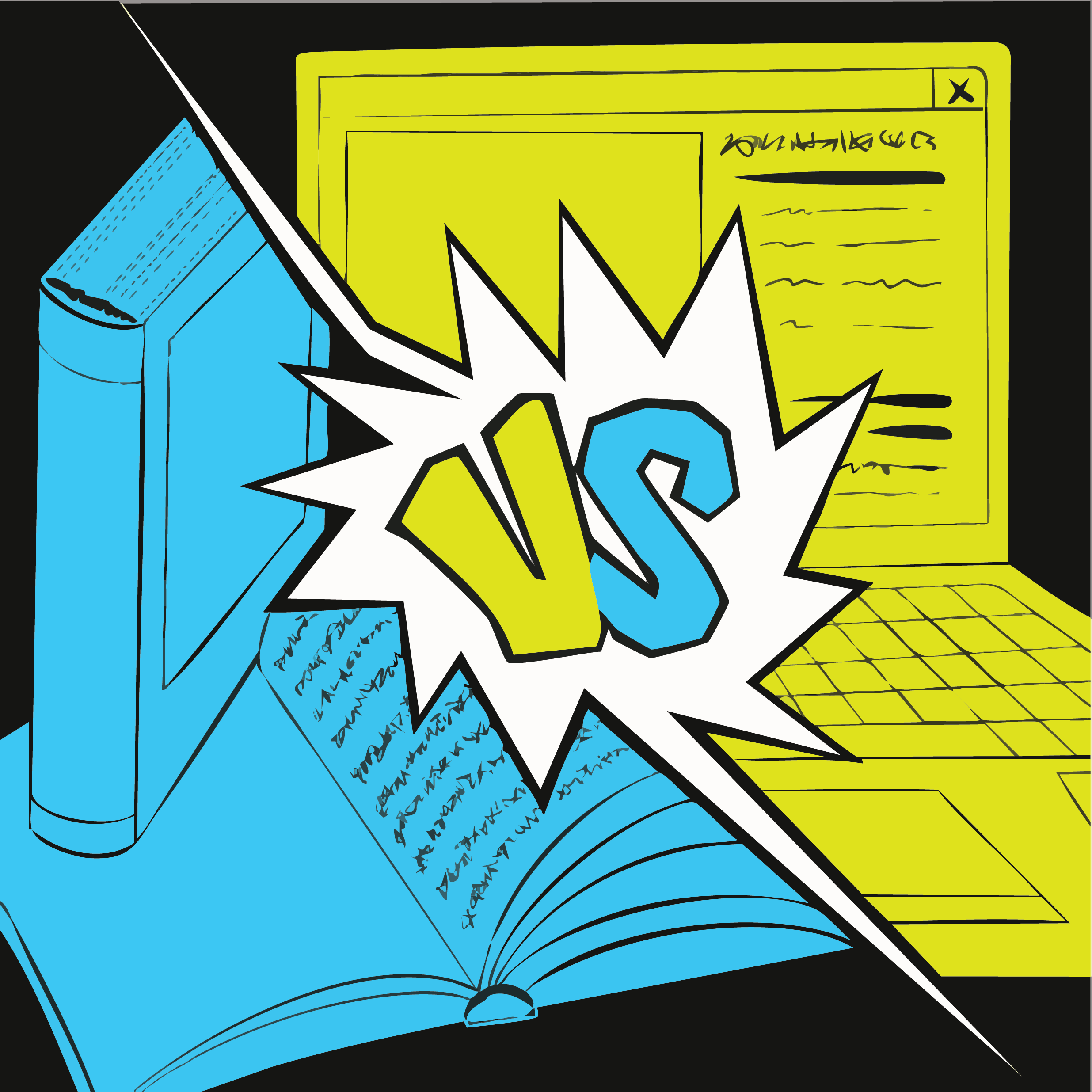
Illustration by Breanna Newburn
Article by Madeline Teeter
NEWBERG, Ore. – With the popularization of digital media and the Amazon Kindle’s release in 2007, there has been a 20 year-long debate about which is better: physical books or digital. In a time of increasing digitization, are physical texts still relevant?
When it comes to reading for classes, there are benefits to both sides. “Specifically for an academic setting, it is astronomically easier to stay focused and take notes in a physical book rather than digitally,” said Megan Kenyon, a sophomore English major. “Although I do appreciate digital things that I can print out because it saves money on books!”
Other students agreed with Kenyon’s assessment. “The act of physically annotating a book is vital to both my comprehension and retention of the material,” said Claire Botts, a junior mathematics major.
“Something about having the physical book in front of you helps you to cement the information in your brain a little better and to draw more complex connections, as opposed to just staring at a screen for hours,” said Ava Bovenkamp, a sophomore biochemistry major.
“I have discovered that I learn much better from physical books and paper handouts,” said Anneke Alex, a junior biochemistry major. “When I try to read PDFs or other online files, I have a really hard time focusing and understanding what I’m reading.”
While students generally agreed that note taking is an easier experience with physical texts, they acknowledged that digital copies are more accessible. “The actual reading is more enjoyable on paper, but the convenience of digital is just so helpful,” said Sydney Staley, a senior engineering major.
Price differences in the two mediums also influence some students in their choice. Lucas Drake, a freshman English and accounting major, said “I greatly prefer physical books but e-books are cheaper.”
“While physical textbooks are heavy and more expensive, I like not having to stare at a screen for every assignment that I do,” said Tyler Lamp, a freshman biochemistry major. “It is worth the extra hassle, unless the price difference is $50.”
Kinsey Burke, a sophomore English major, affirmed this sentiment: “If I have to use digital books, I will use them for classes…but it is not my first choice. At some point I regret not buying them physical.”
Digital books can be beneficial to academic settings given their accessibility. When reading for fun, however, most students expressed a strong preference for physical copies. “I prefer to use physical books because I grew up using them all the time,” said Burke. “I love the smell and general sensory experience you get from reading them.”
“There is something so timeless and pure about reading from a real book,” said Botts. “No blue light or dead batteries, just ink and paper. No distracting notifications, just a story. No scrolling or clicking, just the peaceful sound of rustling pages.”
Taking a break from technology in a highly digitalized world is a draw of physical books. “If I decide to sit down and read a book for a while, it is usually to unwind at night when I don't want to do anything relating to technology,” said Lamp.
“When I read for fun, I mostly read physical books because that's what I grew up doing. I have read books on Libby occasionally,” said Audrey Grice, a senior English major. “However, I don't like it as much because part of the appeal of reading books is getting off my devices and taking a break. Reading on my computer isn't the same.”
Physical books also have a sentimental appeal to readers. “There is something greatly enjoyable and nostalgic about flipping the pages of a book, about relishing the progress made in the book, calculating fractions of the book's width to determine how far through you are,” Drake said. “An ebook takes away those simple pleasures.”
“It’s like the rare moment nowadays where a grandparent sits you down and shows you an old scrapbook or photo book,” Burke said. “It has value in the experience it gives you and I feel like going digital makes those experiences with books and papers a lot more forgettable.”
Burke acknowledges the non-sentimental effects of digitization. If the Internet were to go down tomorrow, we’d lose access to thousands, maybe millions of digitized books uploaded to the internet. That would truly be a tragedy.”
Despite the still widespread love for physical books, digitization continues to be pushed as the most efficient way for distributing information. For example, many newspapers have reduced how often they print physical issues or moved completely online.
However, there are still people who want to hold onto those issues in a concrete way. “The digital issues are convenient but nothing can quite compare to the feeling of flipping through a magazine and reading an assortment of articles,” Bovenkamp said. “Plus, people are more likely to read articles they might not otherwise care about if it's physically sitting around for them to look at.”
“I love having something physical I can engage with and I know I’m not the only one out there who feels that way,” Burke said. “I will definitely keep reading physical copies and actively seek them out for that incredible experience.”
“Also, there is something about having your work published in print,” Drake said. “When your work is published online, it feels lesser–nearly fake.”
While digitizing texts can make information more widespread and accessible, which is beneficial for classes, physical documents lead to a more fulfilling experience for the reader.