Photos by Molly Arias & Holly Shelton
Article by Avery Duffy
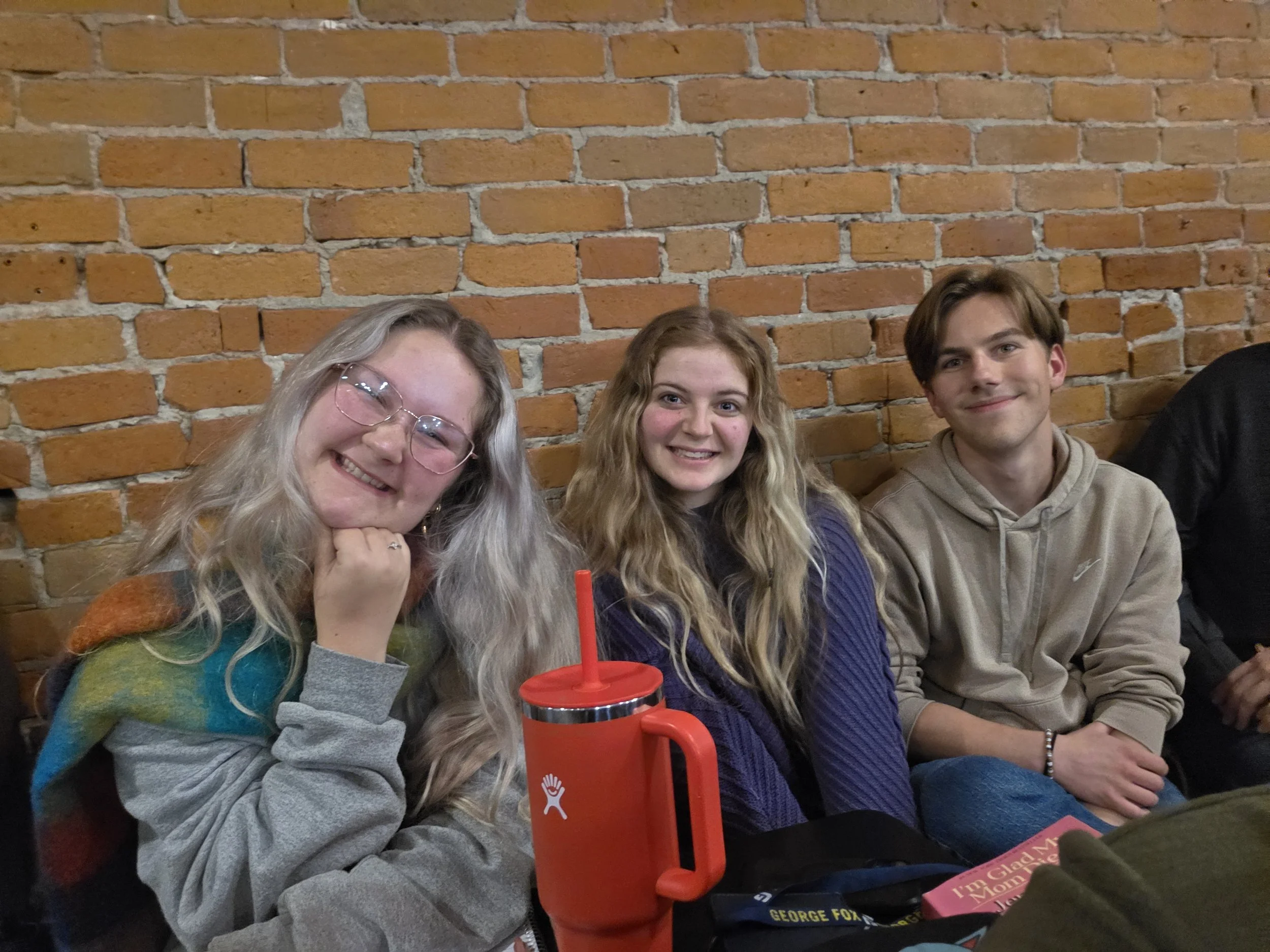
NEWBERG, Ore. – On a chilly fall night, stray leaves litter the downtown streets of Newberg as rain sprinkles the concrete. A warm glow cascades from the tall windows of Chapters Books and Coffee (Chapters) as a crowd gradually forms inside.
Two men, Paul Pastor and Brooks Lampe, trade places reading from their intimate poetry collections, captivating listeners with their words. The poems are filled with odes to nature, religion, seasonal imagery, complex emotion and tranquility amidst hardship.
The night followed a structure switching back and forth between Lampe’s and Pastor’s reading of poetry to blend their styles and reflect their individuality.
Lampe began the night by reading four poems, followed by Pastor reading four of his own. They followed in a decreasing pattern, reading three poems, then two, finally concluding with a poem that applied to their individual works as a whole.
Pastor predominantly shared works from his newest collection “The Locust Years.” His poems follow the seasons of the year. Pastor said they reflect on, “joy, loss, beauty and what [he] calls the ‘hopeful despair’ of grief.”
Pastor’s collection arose from raw personal experiences with family and the comfort that followed from his faith and relationship with Jesus.
The core of his work comes from Joel 2:25: “And I will restore to you the years that the locust hath eaten…” As a whole, “The Locust Years” follows staggering wisdom and “irrationality” underneath “the deepest kind of hope,” said Pastor.
Lampe read from his newest collection “Sesquipedalian Rain Chant,” a product of his first pursuits in taking poetry more seriously.
The collection also focuses on movement through seasons–specifically September though April–utilizing enjambment, bright themes and fast pacing.
Being a professor, Lampe wanted the designated months to reflect typical school year routines. As a member of the Orthodox church, Lampe also wove in the liturgical year, knitting in key events of the 12 feasts, using Mother Mary as what Lampe terms a “seasonal container.”
Both poets focused on the nature of the Pacific Northwest’s imagery which helped their work’s compatibility when shared together at Chapters.
Pastor’s love of poetry came from his childhood. In exchange for a memorized rhyme, his grandfather would give him a silver Eisenhower dollar.
The older Pastor got, the more literature he consumed. “Milne, Stevenson, Rossetti, Tennyson, Longfellow, and–my favorite–Poe. And, of course, lots of the delightfully irreverent Shel Silverstein,” said Pastor.
While he always enjoyed literature, Pastor didn’t start taking his own poetry seriously until seven years ago, though he has been writing it since high school.
Similarly, Lampe picked up the hobby in graduate school as part of his PhD, but didn’t pursue publishing his work until two years ago. Writing his PhD dissertation on surrealist poetry, he was always intentional about consuming and writing poetry, but kept personal publications to a Tumblr blog and miscellaneous online forms.
Lampe always saw himself as oriented towards academics over writing. However, his dissertation opened his eyes to new aspects of poetry. “Poetry is very powerful and it doesn’t just need to be fun and surreal,” said Lampe.
While it is obvious that, to Lampe and Pastor, poetry is important, what should we see as the point of poetry? Why are poetry reading nights, the poems and the poets behind the collections important?
“Poetry is the whiskey of literature. It is distilled language, the close cousin of both song and dream,” said Pastor. “Good poetry is exceptionally potent, pure and memorable. We worship in poetry, love in poetry, play in poetry, mourn in poetry.”
Lampe's own view mirrors Pastor’s representation of the sacred nature of poetry. To him, poetry is “divine language and in some ways spiritual.”
To Lampe, poetry has both spiritual and technical aspects. “[Poetry is] intensified attention to the sound of language and the shape of thought,” said Lampe. But poetry also caresses the soul, pierces deeply and crunches raw expression into incomprehensibly impressive concision.
Pastor emphasizes the necessity in practicing poetry. “It is free and deeply human, connecting us to the world and to the experiences of others,” said Pastor.
Pastor’s advice to aspiring poets is to simply be immersed in good poetry, deconstruct anxieties around publication and to learn more about the poetic craft. “Approach all of it with curiosity and generosity…see if you have something to add to it,” said Pastor.
To Lampe, it is important for poets to be in community with other poets and writing groups, to establish discipline and to work towards publication right away. “Get started as a student, as a young adult. There is no reason to wait,” said Lampe.
Both poets are grateful to be able to combine religion with their work.
For “Sesquipedalian Rain Chant,” Lampe worked with an atheist publisher who still valued the religious themes included in his collection. Lampe distinctly wanted to honor authenticity within his faith experiences while removing any evangelical aggression.
Pastor sees an ongoing renaissance of Christian literature and art, finding joy from fresh work. There’s beauty in a surplus of fresh writers and so much potential.
“Some of tomorrow’s classics are being published right now. We need to join together–as we did on Friday night–and come together around new literature,” said Pastor. “The friendships and warmth of those connections are a delight.”