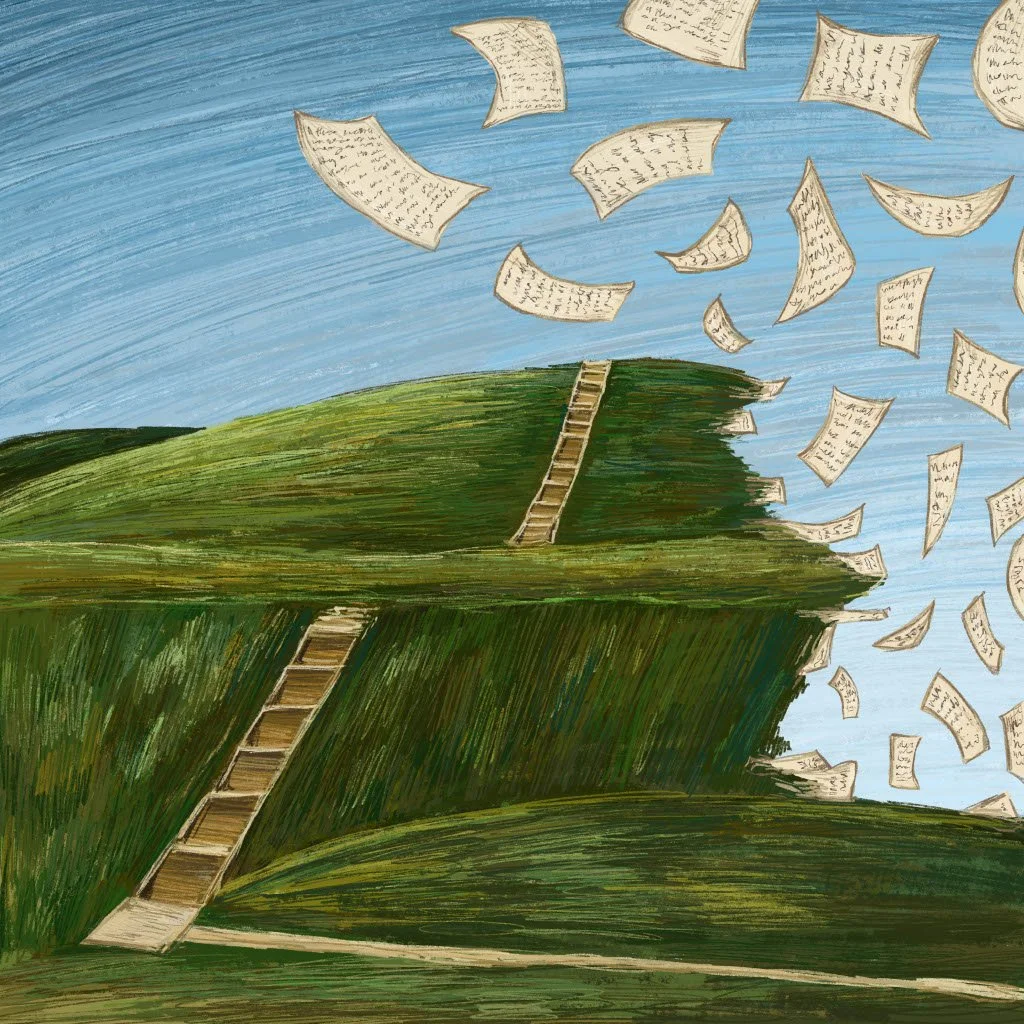
Illustration by Drew Buckmaster
Article by Avery Duffy
In a recent American Literature class, students were presented with the concept that literature is in dire need of expansion, broadening the term to encompass everything: more specifically, art.
This thesis has good intentions, prioritizing inclusivity of ideas shown through differing art forms, but categorizing art into literature diminishes the value of cultural distinctions in storytelling and knowledge-sharing capacities.
In class, Cahokia–once an early Native American city, now an archeological park which preserves the site–was used to suggest unwritten art forms may count as literature. The idea seemed to emphasize Indigenous culture and how Native art can display knowledge, such as time and season, making the content value equivalent to written works.
Therefore, literature should just be an umbrella term for all ways of sharing information.
I agree that no matter the medium, art or literature, the content holds the same value; it is also important to see how classifying art and literature as one can be a new means of “colonizing” Indigenous culture, whitewashing the uniqueness through Western standards of what literature was and is.
In a conversation I had with Arlo Nordeng, English major and photography minor, he said, “They [art and literature] are both about the experience of living,” further explaining that if one category is broadened too much, we risk reducing the subjects core foundations.
What, then, are the core foundations of literature and art in their respective categories?
Literature, as defined in the Merriam-Webster Dictionary, is the body of a written work that is produced in a specific language, prose or verse. Art is instead defined as decorative, illustrated or using aesthetic elements purposefully crafted through skill, creativity and imagination.
While it is clear that art and literature go hand in hand in the humanities, unifying them discards the importance and relevance each category provides to its respective subject. Humanities is already an umbrella term that combines human societal and cultural subjects. So, using literature as another encompassing topic stifles the uniqueness of written and physical works.
By not allowing breathing room for art as an individual, we discount cultures that strictly use and have used art for communication, expressing ideas, knowledge and creativity. There is beauty to be found in the discovery of cultural distinctions, and these differ depending on how a historical work is presented: whether written as prose, poetry, verse, etc; or being artistic such as sculpture, painting, dance, theatrical performance or the virtually limitless ways art may be represented.
I can see how broadening a definition of literature may balance a sense of inclusivity to express knowledge outside of just written works, but rather than removing artistic endeavors from their own category, the utmost value can be derived from recognizing art as more than simply aesthetics.
While yes, art by our definition is decorative and contains aesthetic value, other cultures can have a deeper connection and meaning. Cahokia displays a perfect example of “the physical” containing knowledge, understanding and problem-solving abilities.
The same goes for literature. Written works don’t merely express knowledge or tell a story, there are specific techniques found and embedded within language structures.
Writing is an art form, but it is not one that should encompass all that art as an individual subject has to offer. By writing this, I am expressing an opinion and knowledge of a subject, but this same expression can also be done through painting, sculpture or even dance.
Storytelling, expression, knowledge and ideas are all valuable and need to be shared. How these subjects are shared is unique and dependent on culture and time period, therefore I truly believe maintaining a distinction between literature and art is crucial to future historical recollection.
It is not crucial to just history, but to the subject's own identity, allowing each to ebb and flow through one another, distinct, yet in harmony.